A shiny new website about my rescued poetry is now live over here.
You can read sample rescued poems there and read about how I came up with the idea. I will be adding rescued poems regularly.
You are most welcome to visit and comment!
Poems rescued from text
A shiny new website about my rescued poetry is now live over here.
You can read sample rescued poems there and read about how I came up with the idea. I will be adding rescued poems regularly.
You are most welcome to visit and comment!
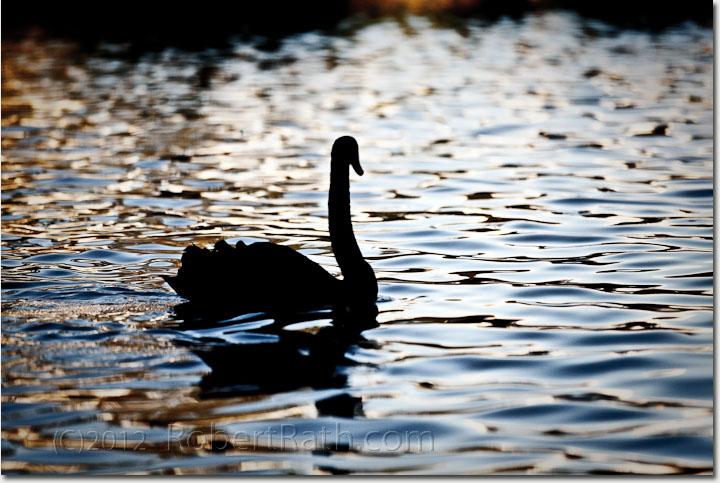
Silhouette Swan. Photo by Robert Rath from Robert’s website.
The inspiration for today’s poem is two literary hoaxes; one in Colombia and one in Australia.
Gabriel García Márquez, Colombian novelist and winner of the 1982 Nobel Prize for Literature, died last week (17 April). Back in 1999 he was treated for lymphatic cancer. On 29 May 2000 a farewell poem, titled ‘La Marioneta’ or ‘The Puppet’ and supposedly written by him, was published in the Peruvian daily La Republica. The poem was in fact written by Mexican ventriloquist, Johnny Welch, for his puppet sidekick ‘Mofles’. Read about it here.
The Autumn 1944 issue of Australian avant-garde magazine Angry Penguins published a set of poems by Ern Malley. They turned out to be hoax poems written by poets James McAuley and Harold Stewart as a “literary experiment”. Read about it here.
Dymocks bookshop in Adelaide is hosting an Ern Malley tribute reading this evening at 6 pm.
For today’s rescued poem (you can read about that process I’ve developed here) I used two source texts: the first is the actual poem, ‘The Puppet’, purported to have been written by Marquez. The second is the text of the preface and statement to the Ern Malley poems (collectively called The Darkening Ecliptic.) The poem title is a combination of two interesting images I chose from the poems: ‘black swan of trespass’ and ‘trembling intuitive arm’.
Trembling black swan
Sleep light and dream of cream things
wait for the genuine moon
to serenade the stars;
let each line loiter, knowing
that wings teach man to walk
all the way, exposing
him to tears and sun
and poems; he will live
his tiny span of life
and at a certain dying moment –
when his little rag
of soul is falling, falling –
he will fly.

Pixellation. Photo by Robert Rath from Robert’s website.
Today I was browsing the book Adventures in Form for inspiration for today’s poem and I came across a footnote which said that Reginald Fessenden broadcast the first human speech over a radio with the message “1, 2, 3, 4. Is it snowing where you are, Mr Thiessen? If it is, telegraph back and let me know.”
So I fell down another rabbit hole and found this article about him .
I decided to write a ‘rescued’ poem (you can read about that process I’ve developed here). I rescued today’s poem from the IEEE article and a Wikipedia article about snow.
This rescued poem is different from most of my other rescued poems in that the subject doesn’t deviate significantly from the original source texts; that’s probably because I was intrigued by Mr Fessenden the innovator and how unacknowledged he was/is.
Is it snowing where you are, Mr Thiessen?
The voice he heard was crystalline and thin
like the air of thundersnow and cloud
through which the waves of sound were broadcast.
Mr Thiessen was indeed astonished
by the miracle of wireless speech:
prescient question about that stormy coast
and its thick and frozen landscape; acoustic echo
from the gifted Mr Fessenden.
And a man’s own story is like snowflakes:
unique and thin words wafting in the ether
trapped in a transmission atmosphere
settling onto giant private icebergs;
or even snowflakes hardened into hail,
crushing and dampening a private dream.
Day 27. A suggestion here prompted me to plug my name into this anagram generator. I set a limit of a minimum word size of three. It generated 1,633 words and I eliminated repeating words using this tool. Then I randomised the list 14 times (the number of letters in my name).
I rescued poem number 27 from the pool of words.
Enter, not for its life
Soften sire,
relent!
Felons loiter,
leer
felines trifle
jest,
jot notes
sort linen.
Foes riot, flee.
Lone son stolen.
Stonier inner filter
jolts,
tenor tones.
Lifers sneer.
Sinner risen,
feels soft,
frees son.
Listen:
elfin seer siren
silent for eons!
I usually rescue a poem from prose texts (read here about my rescue process).
Today, however, I thought I’d rescue a poem from two poems, each called ‘The Fish’. One is by Marianne Moore and the other is by Elizabeth Bishop.
I read Elizabeth Bishop’s poem once, quite some time ago, and I still haven’t read Marianne Moore’s poem, so I am not yet familiar with the content of either poem.
The surprise with the poem I rescued is that it’s not about fish at all.
I love surprises, and I love this rescue process.
old
terrible things
in an ancient, sun-cracked face
age burns like hatchet sun
its swiftness, weapon-like:
                marks not mine are mine.
orange crimped feathers
white lilies
big spread rainbow of shiny glass
are rusted tinfoil.
                marks not mine are mine.
crisp yellowed stare
from my eyes like medals –
not medals,
like barnacles,
like sea stars;
my grim wisdom, grunting,
lip down, sullen,
shafts of fight
abuse my aching jaw,
rainbow strokes the turquoise water
rainbow shapes speckled jelly-fish
rainbow keeps fish of youth submerged.
                marks not mine are mine.
everything is here:
my strips of tarnished skin
are rust-brown evidence
of a shiny edifice
shifted;
tremendous heavier flesh
attached to tiny little bones.
Last night I went to the 10th anniversary celebration of Poets’ Corner, a wonderful poetry group that hosts guest poets every month (Alison Flett and I were guest readers at the most recent one in January, which was the evening before friend and poet John Pfitzner passed away). Yesterday’s celebrations included a tribute to John. Sean Gilbert delivered a moving opening speech about poetry and prayer, and how poetry, like prayer, is a ‘reaching out’.
I was thinking more about this, and about how some prayers are poetry in and of themselves, if you slough away the heavy chains of association with man’s religious prejudices.
Raised a Roman Catholic, my childhood was sprinkled with learning and ‘reciting’ prayers. I wondered what poem I could rescue from a selection of prayers that I know so well. I chose seven: the ‘Our Father’, the ‘Creed’, the ‘St Patrick’s Breastplate’, a ‘Guardian Angel’ prayer, the ‘Salve Regina’, Psalm 23 (‘The Lord is my Shepherd’) and the ‘Act of Contrition’. To be consistent I took the text from here.
you are the banished
Almighty guide descended
eyes of earth toward evil resolve.
In the darkest valley of temptation
a quiet stranger
sighs,
dies.
Spirit me to forgiveness
beside rose waters,
beneath the light of grace,
behind gracious power;
restore me to hope
above buried heaven
near a hallowed presence
through days of mercy;
lead me to believe
that the worthy shall lead,
that a god shall comfort,
that tears for a mother and father
are tears of an angel,
that to walk above waters
is communion with earth
and that when life and light are done
I shall come
in from exile.
here.
I just read today that yesterday, 7 April, was William Wordsworth’s birthday – he was born in 1770. He figured heavily in my introduction to poetry: my mother and I used to recite together ‘Lucy Gray’ and ‘Daffodils’ when I was about six or seven years old.
The two poems are very different: ‘Lucy Gray’ tells the story of a young child who goes missing in a snowstorm, while ‘Daffodils’ recounts the joy experienced by the poet when he comes across ‘a host of golden daffodils’ when he was out for a walk.
So I decided to shake up the text of these two poems and see what poem was waiting to be rescued. Here’s the result, which is definitely influenced by how well I know the subject of both poems.
Happy birthday, William. Thank you for your poetry. I hope you’re not turning in your grave at this.
She is all, and night is just
Sound never looks this lonesome.
She wandered, small,
overlooked, scarcely there.
She was inward, broken,
dancing vacant
on solitary wild.
Night was tossing
the wretched daffodils.
She danced, wanton,
chanced a glance
at lantern moon
shine sprightly golden
reached downwards beside
on milky snow.
She gazed wide at lonely heaven
and through sparkling
stars tracked waves of twinkle.
She danced, pensive,
yonder mother mountain
a steep, stormy rise homeward.
She danced, wept,
her footmarks lost,
never to be seen.
Today’s poem had an interesting birth. Earlier in the day I was reading ‘The Ubuweb: Anthology of Conceptual Writing’ . The article discusses the idea that conceptual poetry turns its back on traditional ‘romantic’ notions of poetry being a vehicle for emotional expression and instead, embraces procedure and logical process.
Later I was thinking about ideas for today’s poem. I decided to go through my ‘rescued’ poem process (read more about that here) using the Ubuweb article about conceptual writing as my source text.
Here’s the rather interesting result: a conceptual/constrained piece about itself.
art crossings
poetry experiments
misapplied language
allowed,
respaced;
the presented form
scored,
conceptual;
extraordinary writing abstractions,
which the story words,
string legible pleasures and
bleed verbal probabilities,
reengineering écriture possibilities;
a collection of cannot language
a recall to chance concept
vibrate structures
into sculpture:
the idea of
truth itself
embodied
in rigorous procedure
and derived into presence
Mayday Mayday, it’s Rescue Tuesday!
I rescued this week’s piece from My Life in Advertising by Claude C Hopkins (p 205) and The sea by John Banville (p 143).
Freeze frame
Summer afternoon pocketing thunderous idleness in the dark.
Erotic encounter
covert kiss
black-and-white screen
flickering
fading
ghosts of desire sitting in pitch-dark intensity
for hours,
manic fumbling,
twitched satisfaction
deprive primal intensity;
confinement
reputation,
balls for breakfast
conscious phantoms lurch
from joy to grey
approve to disreputable
filled fingers to wanton waste,
picture-house main feature to forgotten poverty.
It’s Rescue Tuesday! I rescued this week’s piece from Captain Corelli’s Mandolin by Louis de Bernières (p43) and Sons and Lovers by D H Lawrence (p107).
Convalescence
White-skinned daughter
simple embodiment of profound good
soul scattering naked comfort
like snowflakes in your presence
secretly swallows
your subversive blackberry words
from the black of fallen fruit
to the whiteness of snow
as wet as warm touch
softly
slowly
beloved feels
healing faith
scar of peace.