Blog

  • Poem a day for 6 April 2018: When the dead listen

    The rescued poem for today is from pages 6 and 54 of The Devourers and Marie Tarnowska respectively, both by Annie Vivanti Chartres.

    What is interesting is that in the final four stanzas, words are mixed up somewhat, as if the speaker hasn’t quite remembered the way language is usually ordered.

    When the dead listen

    Sometimes I call to my dear mamma, dead;
    as cool as my ancestors, shrivelled and old.
    Crying her name, I thought, would have helped
    but she is unmoved in the depths of the snow…

    …stay your tears this time
    say you wish me well
    they came to see me lowered
    I died for want of warm

    what your well of tears
    don’t say: wish me time
    lowered into warm I want
    I died in what I came for

    who were you my last
    my strange my solemn fair
    I finished and I asked
    in winter marble lain

    my fair, you were my last
    my want my dear my strange
    the solemn marble asked
    in winter I was lain

  • Poem a day for 5 April 2018: The gods at breakfast, darkly

    Day 5: I’m alive!

    I’ve rescued this little poem from pages 98 and 78 of The Devourers and Marie Tarnowska respectively, both by Annie Vivanti Chartres.

    The gods at breakfast, darkly

    I kissed the sun on the mountains.
    I blew the breeze on the lake.
    I rang the bell in the morning.
    I greeted the unborn child.

    The lady in blue is a beauty,
    behold her sweet ivory face.
    Salute her: how could she answer,
    stiff in her bare solitude?

    I threw off my fine scarlet slippers.
    I lifted my skirts and my sheets.
    See my mouth, open to know you?
    Hear me? Yes. That is me, laughing.

  • Poem a day for 4 April 2018: What the photographs said

    Today’s NaPoWriMo poem is rescued from pages 125 and 94 of The Devourers and Marie Tarnowska respectively, both by Annie Vivanti Chartres.

    What the photographs said

    Who are the ten women in these photographs,
    sour-faced, haughty, silent?
    On one, I hear that pearl necklace
    as it strings a tone of terror
    like a polished weapon.
    On another, the tortoise-shell combs
    would have taken the eye out of her head.
    The game of night and day
    the game of light and dark.
    Of course, I see you and me
    in these pictures:
    in the polished glass brooches
    in the enormous wild eyes
    in the clenched little fists.
    Silver shells all in a row.
    On the back,
    initials,
    and directions to kill.

  • Poem a day for 3 April 2018: strange terrible things

    Day 3: today’s offering is from pages 69 and 70 of The Devourers and Marie Tarnowska respectively, both by Annie Vivanti Chartres.

    strange terrible things

    poets
    string sorry lyrics
    page
       by
          page
             by
                page
    looking for the light of tenderness
    shooting up the drug of memory
    but almost always
    they take me
    to some black-edged abyss
    where deadly night engulfs
    my pale blue tears
    where strange things –
    oh strange, terrible things –
    come from that chasm,
    drag me to gehanna*
    and dare me
    (crackling, shaking)
    to look…

    * destination of the wicked

  • Poem a day for 2 April 2018: Notes of ruin

    I’ve rescued today’s poem from pages 88 and 202 of The Devourers and Marie Tarnowska respectively, both by Annie Vivanti Chartres.

    Notes of ruin

    Dreamy young mind
    a fortune-teller’s fool:
    as crystal flashed her gaze
    soothsayer lifted a veil
    and, by superstition or intuition,
    she believed the words.
    Bird-thought poison touched her gold-bright spirit.
    Her fair kindness and silver smile
    turned to notes of ruin.
    Now she is a room with doors shut.
    Now, sullen little grim girl’s eyes –
    hand, lips, brow trembling –
    notice strange sorrow
    discern dark sinister moments
    but never notice the miracle at the window of her memory.

  • NaPoWriMo 2018: poem-a-day blast-off. Don’t leave

    I’ve written a poem a day each year from 2012 to 2015, but in 2016 I needed to concentrate on finishing the PhD and last year, well, I was having a little break. So now I’m back in the write-and-publish-a-poem-every-day-in-April saddle.

    This year I decided to do something different: each day I will write and post a rescued poem using the same two source prose texts. You can read about the rescue process here. Rescuing a poem is about writing a new poem from two pages of text from two books following a strict, repeatable process.

    It will be interesting to see if any themes emerge, given that the base vocabulary and style will be consistent. I chose books of which I had electronic copies so that I could eliminate the transcribing element of the rescue process. I can simply copy and paste the pages of text from the books, which makes rescuing much less onerous to do daily.

    The two books are The Devourers and Marie Tarnowska, both by Annie Vivanti Chartres. She was born in London in 1866, of Italian and German parents, and in 1892 she married the Anglo-Irish journalist and lawyer John Chartres. (You can read more about her here.)

    I’ve rescued today’s poem from pages 302 and 67 of The Devourers and Marie Tarnowska respectively.

    Don’t leave

    Pale perfect
    face of a woman:
    tired in foolish laughter.
    Big sour
    spine of a man:
    deep, in angry silence.
    This, this is the darkness of that world
    where ‘sorry’
    is the sacred missing,
    where shapeless hatred and careless jealousy
    devour the mute cry of hope.
    This, this is the darkness of that world:
    she cannot step into the fast blue sky of morning,
    she cannot stop the wild stars of an evening.
    When she shivers, a breath of air might kill her.

  • Rescued poetry featured on Jacket2

    I’m absolutely thrilled that the delightful Jerome Rothenberg has featured my rescued poetry on Jacket2, a leading online journal that offers commentary on contemporary poetry and poetics. You can read it over here.

    Jerome is an eminent American contemporary poet who started his career as a translator of poetry. He is also a highly regarded poetry anthologist, editor and poetic theorist. One of the most well-known anthologies for which he is responsible is the beautiful Technicians of the Sacred, a collection of poetry and incantations from indigenous peoples around the world.

    You can read more about Jerome on the Poetry Foundation website. Thank you, Jerome.

  • How a pirate queen helped me become a doctor


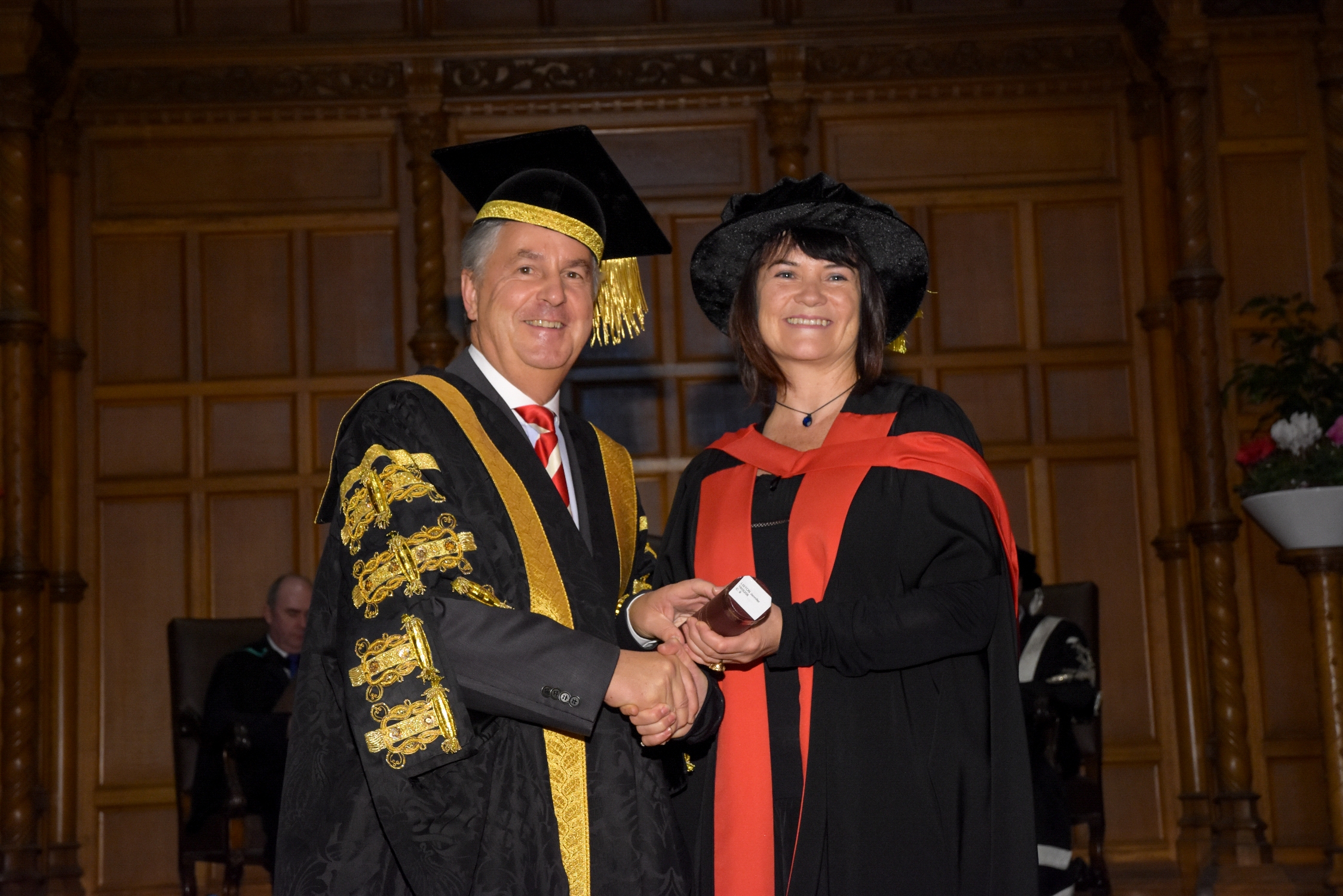
    Rear Admiral Kevin John Scarce AC, CSC, RANR, 16th Chancellor of the University of Adelaide, presents me with me parchment on 2 May 2017. As he shook hands with me, he whispered: “That sounds like a really interesting thesis”. But I bet he says that to all the doctors.

    I’ve been asked several times what I’ve been working on in the creative space for the past while.

    So this is what I’ve been up to: I was awarded a PhD in Creative Writing from the University of Adelaide in March this year, and I graduated in May. What a wonderful day that was, made all the more special by the presence of my darling sister Susan and her husband Daragh, who came all the way from Ireland for the event!

    I gather it’s not often that ‘fun’ and ‘PhD’ are in the same sentence, but for me it was exactly that: fun, and a real privilege. From the beginning I treated it as a major project, turning up every day to ‘work’ in my (shared) office at the university (hurray for room 624!). I was fortunate to have two excellent supervisors: Jill Jones, senior lecturer at the university and herself an internationally recognised prize-winning poet; and Professor Dorothy Driver, a distinguished English literature scholar and academic.

    I wrote a collection of poetry—87 poems all up—and an exegesis, which is a 20,000-word critical explanation of the context and themes associated with the creative work. The collection incorporates poems in the voice of Grace O’Malley (Gráinne Mhaol—pronounced Graw-nya Wail) interspersed with what I call ‘rescued’ poems. (My other website rescuedpoetry.com lists the steps of this process I developed, and features several examples.)

    Gráinne was a powerful sea-faring chieftain who lived in the west of Ireland from 1530 to 1603. She was ‘some woman for one woman’; during this time—one of the most turbulent political eras in Ireland’s history—she and her crew traded by sea with Scotland, Spain and Portugal from her base in Mayo.

    Irish contemporary historical literature has mostly overlooked Gráinne in spite of her prominent role in politics. She pops up quite frequently in various English political papers and communications, however, because of how irritating she was to the English regime which was busy trying to colonise Ireland at the time. In various dispatches she was called ‘the nurse to all rebellions for forty years’ and ‘a director of thieves and murderers at sea’. It was through subsequent retelling of her seafaring exploits that she came to be known in Ireland as the ‘pirate queen’. In the deeply researched biography Granuaile, Grace O’Malley—Ireland’s Pirate Queen, Irish author Anne Chambers fleshes out in great detail Gráinne’s personal and political life.

    According to a letter written in the 1950s by my great-Aunt Angela Russell (née Coyne), sometime in the mid-1800s my great-great-grandfather James Coyne married an O’Malley woman who was related to Gráinne. Of course, Gráinne’s direct descendants are more likely to be O’Flaherty or Bourke—Gráinne’s husbands’ surnames—but that doesn’t rule out the possibility that we have a few globs of O’Malley blood running through us! The Brownes, who are the direct descendants of Gráinne’s youngest son Tibbott, owned and lived in Westport House until earlier this year.

    So, back to my collection of 87 poems: these consisted of 37 Gráinne compositions and 50 ‘rescued’ poems. In the Gráinne compositions I placed Gráinne at different points in her life but also, in a sort of subversion of the idea of straight biography, I situated her in the mediaeval past and in the future via her dreams. I viewed the re-worked and re-created stories from her past and future as a way of honouring her for having been written out of history. I drew on the stories about her that I’d heard as a girl in Ireland, or that were discussed in her biography by Anne Chambers, or mentioned in passing elsewhere.

    I rescued the 50 poems from combinations of 17 texts connected to Gráinne—a selection of factual or fictional biographies of her and a small number of contemporary historical texts. The idea behind this was that the rescued voices would echo and complement Gráinne’s voice, even if in a removed way.

    After three-and-a-half years of researching, writing and editing, I submitted the collection and exegesis in August 2016*. My examiners’ reports finally came back in February this year. I agonised and imagined all kinds of (negative) reasons for such a long assessment period. Imagine my amazement and relief when both examiners (one from Ireland and one from Australia) returned overwhelmingly complimentary feedback and remarks.

    One of the examiners referred to the manuscript as a ‘strong and thrilling poetry collection’ and an ‘inventive and impressive volume of poetry’, and called the poems ‘enthralling’ and ‘strong in voice and polished in their craft’. The second examiner observed that the poems presented ‘richly realised moments’ in a collection that was ‘evocative and technically adept’. I was really delighted to see that both examiners ‘got’ what I was trying to do with this unusual approach to biographical poetry (and my risky creative approach to the academic exegesis—but that’s another story). I was even lucky enough to be awarded the Dean’s Commendation for Excellence!

    I would love if an Irish publisher published the collection, so at the moment I’m working my way through a list: it’s a patient and courageous publisher indeed who agrees to publish the work. The poems combine in a unique way so for example, it’s difficult to select a few poems that ‘represent’ the collection, and submit only those to publishers.

    I was rather upset initially by the most recent, particularly detailed rejection letter. Then I decided to be grateful that he took the time to (hand)write his thoughts to me.

    So, my optimistic self has decided that I’m another rejection closer to being published!

    *Full thesis titles.

    Vol 1 Creative Work
    Grace Notes
    Giving Voice to Gráinne Mhaol, Ireland’s Pirate Queen

    Vol 2 Exegesis
    Saving Grace: Re-Imagining, Re-Placing, and Rescuing Gráinne Mhaol, a Sixteenth-Century Irish Pirate Queen
  • Raining poetry on the streets of Adelaide

    I’m really excited to be a part of this innovative project masterminded by my lovely friend Camille Roulière and her friend Marianne Braux: these ladies have quite literally brought art to the streets of Adelaide.

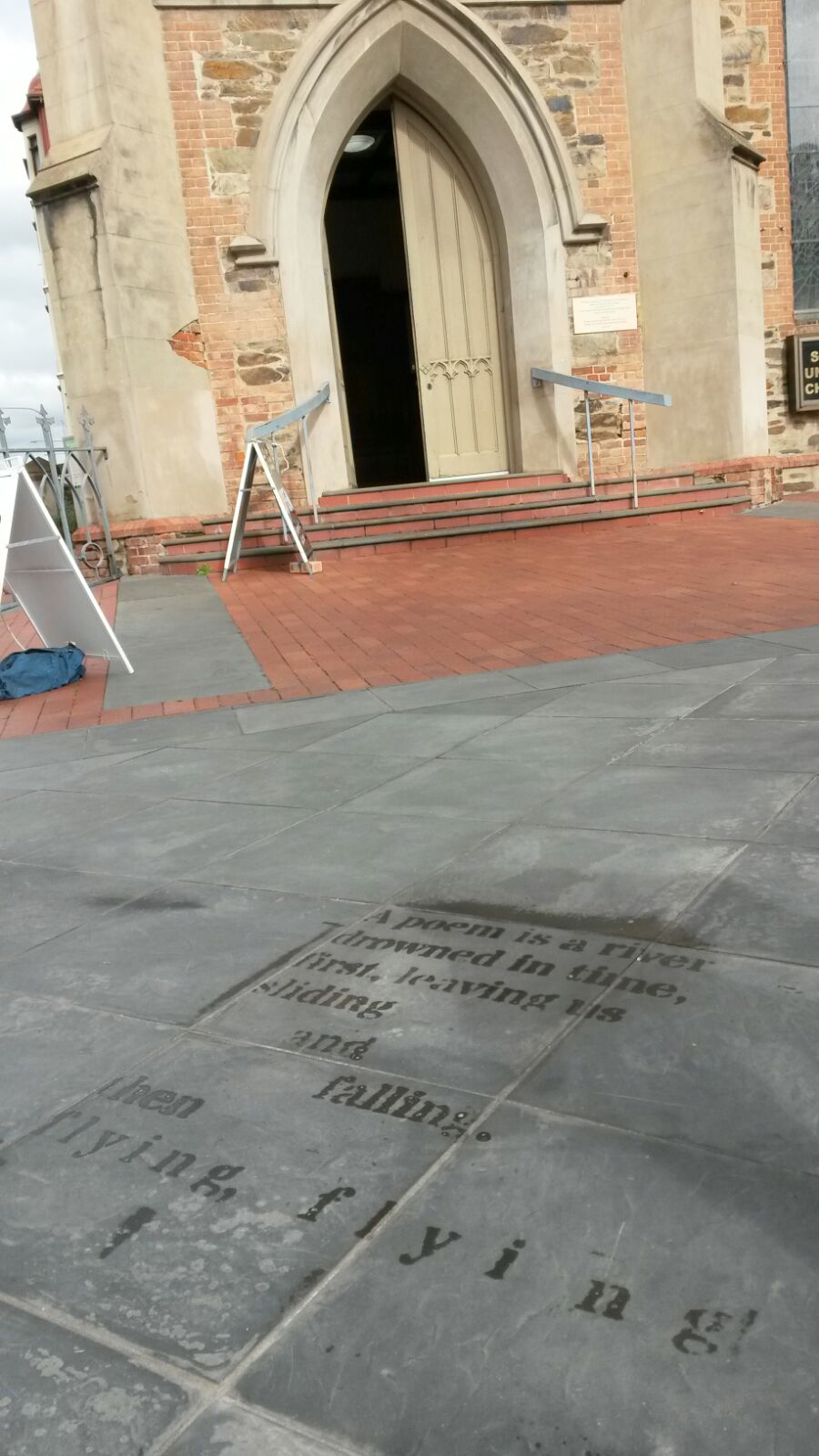
    Inspired by the Raining Poetry project in Boston, Camille and Marianne – both PhD candidates at the University of Adelaide – used a laser at Adelaide’s digital fabrication workshop Fab Lab to create stencils of 18 poems from a selection of Adelaide poets including Jill Jones, Alison Bennett, Banjo James, Avalanche, and Sergio Holas. They then spray-painted the poems through the stencils onto various footpath locations around Adelaide CBD.

    The cool thing is, the tagged poetry only appears when it rains thanks to the water-repelling properties of the paint they used to stencil the words to the pavements. The result? If you’re standing on the western corner of North Terrace and Pulteney Street and it starts to rain, my poem will magically appear to entertain you while you wait.

    You can read about the project in more detail in this article in InDaily.

    This map shows where each of the poems is tagged.

    The project will be launched this Friday 18 August, and is supported by the University of Adelaide’s J M Coetzee Centre for Creative Practice.

    Thank you for including my poem in this exciting project, Camille and Marianne!

  • After a drought… a drop

    It’s been quite some time since my last post – I didn’t submit any poems at all in 2016 for publication (slack, I know).

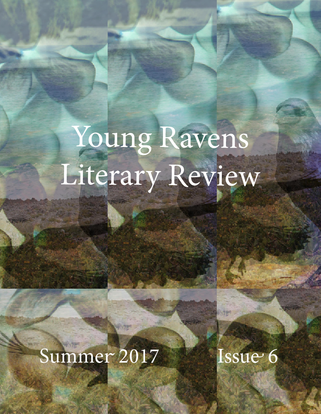
    I did send out one – ‘I will not mourn you’ – at the end of May this year and was delighted that it was accepted for publication in the latest edition of Young Ravens Literary Review. It fitted in well with the theme of the issue, which is ‘Prayers for the Planet’.

    I’d been hoping to find a nice journal for that poem since I wrote it in 2012, so a big thank you to the Young Ravens editors.