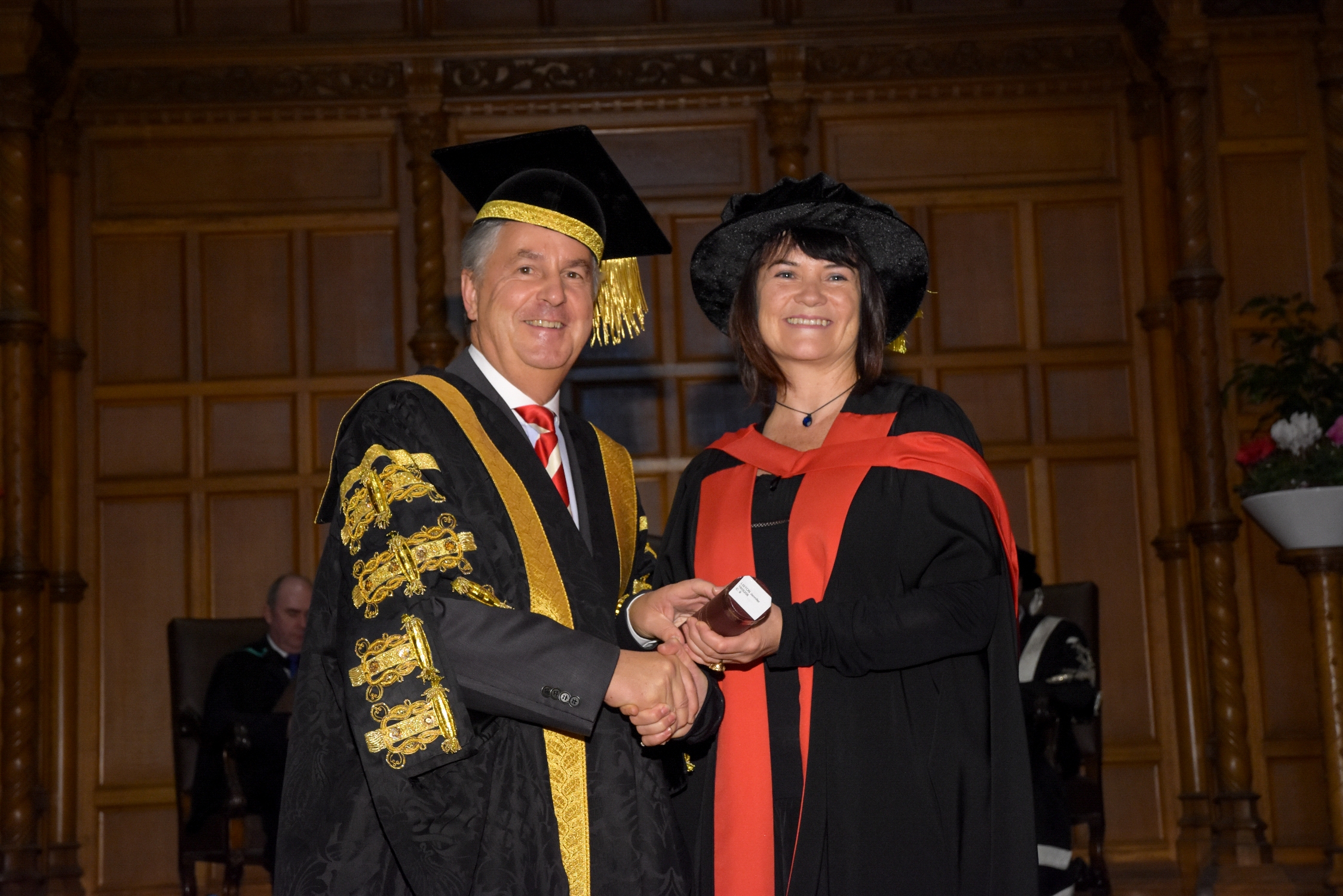
Rear Admiral Kevin John Scarce AC, CSC, RANR, 16th Chancellor of the University of Adelaide, presents me with me parchment on 2 May 2017. As he shook hands with me, he whispered: “That sounds like a really interesting thesis”. But I bet he says that to all the doctors.
I’ve been asked several times what I’ve been working on in the creative space for the past while.
So this is what I’ve been up to: I was awarded a PhD in Creative Writing from the University of Adelaide in March this year, and I graduated in May. What a wonderful day that was, made all the more special by the presence of my darling sister Susan and her husband Daragh, who came all the way from Ireland for the event!
I gather it’s not often that ‘fun’ and ‘PhD’ are in the same sentence, but for me it was exactly that: fun, and a real privilege. From the beginning I treated it as a major project, turning up every day to ‘work’ in my (shared) office at the university (hurray for room 624!). I was fortunate to have two excellent supervisors: Jill Jones, senior lecturer at the university and herself an internationally recognised prize-winning poet; and Professor Dorothy Driver, a distinguished English literature scholar and academic.
I wrote a collection of poetry—87 poems all up—and an exegesis, which is a 20,000-word critical explanation of the context and themes associated with the creative work. The collection incorporates poems in the voice of Grace O’Malley (Gráinne Mhaol—pronounced Graw-nya Wail) interspersed with what I call ‘rescued’ poems. (My other website rescuedpoetry.com lists the steps of this process I developed, and features several examples.)
Gráinne was a powerful sea-faring chieftain who lived in the west of Ireland from 1530 to 1603. She was ‘some woman for one woman’; during this time—one of the most turbulent political eras in Ireland’s history—she and her crew traded by sea with Scotland, Spain and Portugal from her base in Mayo.
Irish contemporary historical literature has mostly overlooked Gráinne in spite of her prominent role in politics. She pops up quite frequently in various English political papers and communications, however, because of how irritating she was to the English regime which was busy trying to colonise Ireland at the time. In various dispatches she was called ‘the nurse to all rebellions for forty years’ and ‘a director of thieves and murderers at sea’. It was through subsequent retelling of her seafaring exploits that she came to be known in Ireland as the ‘pirate queen’. In the deeply researched biography Granuaile, Grace O’Malley—Ireland’s Pirate Queen, Irish author Anne Chambers fleshes out in great detail Gráinne’s personal and political life.
According to a letter written in the 1950s by my great-Aunt Angela Russell (née Coyne), sometime in the mid-1800s my great-great-grandfather James Coyne married an O’Malley woman who was related to Gráinne. Of course, Gráinne’s direct descendants are more likely to be O’Flaherty or Bourke—Gráinne’s husbands’ surnames—but that doesn’t rule out the possibility that we have a few globs of O’Malley blood running through us! The Brownes, who are the direct descendants of Gráinne’s youngest son Tibbott, owned and lived in Westport House until earlier this year.
So, back to my collection of 87 poems: these consisted of 37 Gráinne compositions and 50 ‘rescued’ poems. In the Gráinne compositions I placed Gráinne at different points in her life but also, in a sort of subversion of the idea of straight biography, I situated her in the mediaeval past and in the future via her dreams. I viewed the re-worked and re-created stories from her past and future as a way of honouring her for having been written out of history. I drew on the stories about her that I’d heard as a girl in Ireland, or that were discussed in her biography by Anne Chambers, or mentioned in passing elsewhere.
I rescued the 50 poems from combinations of 17 texts connected to Gráinne—a selection of factual or fictional biographies of her and a small number of contemporary historical texts. The idea behind this was that the rescued voices would echo and complement Gráinne’s voice, even if in a removed way.
After three-and-a-half years of researching, writing and editing, I submitted the collection and exegesis in August 2016*. My examiners’ reports finally came back in February this year. I agonised and imagined all kinds of (negative) reasons for such a long assessment period. Imagine my amazement and relief when both examiners (one from Ireland and one from Australia) returned overwhelmingly complimentary feedback and remarks.
One of the examiners referred to the manuscript as a ‘strong and thrilling poetry collection’ and an ‘inventive and impressive volume of poetry’, and called the poems ‘enthralling’ and ‘strong in voice and polished in their craft’. The second examiner observed that the poems presented ‘richly realised moments’ in a collection that was ‘evocative and technically adept’. I was really delighted to see that both examiners ‘got’ what I was trying to do with this unusual approach to biographical poetry (and my risky creative approach to the academic exegesis—but that’s another story). I was even lucky enough to be awarded the Dean’s Commendation for Excellence!
I would love if an Irish publisher published the collection, so at the moment I’m working my way through a list: it’s a patient and courageous publisher indeed who agrees to publish the work. The poems combine in a unique way so for example, it’s difficult to select a few poems that ‘represent’ the collection, and submit only those to publishers.
I was rather upset initially by the most recent, particularly detailed rejection letter. Then I decided to be grateful that he took the time to (hand)write his thoughts to me.
So, my optimistic self has decided that I’m another rejection closer to being published!
*Full thesis titles.
Vol 1 Creative Work
Grace Notes
Giving Voice to Gráinne Mhaol, Ireland’s Pirate Queen
Vol 2 Exegesis
Saving Grace: Re-Imagining, Re-Placing, and Rescuing Gráinne Mhaol, a Sixteenth-Century Irish Pirate Queen


