Blog

  • Poem a day for 8 April 2013: She is all, and night is just

    here.

    I just read today that yesterday, 7 April, was William Wordsworth’s birthday – he was born in 1770. He figured heavily in my introduction to poetry: my mother and I used to recite together ‘Lucy Gray’ and ‘Daffodils’ when I was about six or seven years old.

    The two poems are very different: ‘Lucy Gray’ tells the story of a young child who goes missing in a snowstorm, while ‘Daffodils’ recounts the joy experienced by the poet when he comes across ‘a host of golden daffodils’ when he was out for a walk.

    So I decided to shake up the text of these two poems and see what poem was waiting to be rescued. Here’s the result, which is definitely influenced by how well I know the subject of both poems.

    Happy birthday, William. Thank you for your poetry. I hope you’re not turning in your grave at this.

    She is all, and night is just

    Sound never looks this lonesome.
    She wandered, small,
    overlooked, scarcely there.
    She was inward, broken,
    dancing vacant
    on solitary wild.
    Night was tossing
    the wretched daffodils.
    She danced, wanton,
    chanced a glance
    at lantern moon
    shine sprightly golden
    reached downwards beside
    on milky snow.
    She gazed wide at lonely heaven
    and through sparkling
    stars tracked waves of twinkle.
    She danced, pensive,
    yonder mother mountain
    a steep, stormy rise homeward.
    She danced, wept,
    her footmarks lost,
    never to be seen.
  • Poem a day for 7 April 2013: just words

    I listened to a ‘Poem Talk’ podcast today of a discussion of Caroline Bergvall’s poem ‘Via: 48 Dante Variations’. The poet collected English translations of the first three lines of Dante’s Inferno from the British Library and arranged them in a certain order.

    (The podcast is here.)

    So I decided to do a little experiment of my own, which turned into something completely different from what had been discussed in the podcast! I selected a poem called ‘Je suis comme je suis’ from the book Paroles by one of my favourite French poets, Jacques Prévert. The first two lines of the poem are:

    Je suis comme je suis
    Je suis faite comme ça

    I translated them, then worked my way through repeating the two lines – but each time I changed the punctuation and/or order of the words without altering the rhythm of the first two lines. In the first few lines I changed a few words. I retained the same number of lines of the original poem (32) and a stanza break at the same point (after line 12).

    The meaning transformed and ended up somewhere quite poignant. Here it is.

    just words

    I am what I am
    I am made that way.
    I am who I am
    I am made like that.
    I am who? I am.
    I am. Made. Like that?
    I am I am who?
    I like that, am made.
    Who am I? Are you
    like that? I am maid.
    Who are you? My eye
    likes that maid, I am.

    I am who? Are you
    who I am? What maid?
    You are who my eye
    likes, you are made you.
    I am. You are. I.
    You are. I am. You.
    I am. You are. I.
    You are. I am. You.
    I am. You are. I.
    You are. I am. You.
    I am. You are. I.
    You am I am you
    You are why. We made.
    You are I, my who.
    You are who, and why.
    You and I, who are.
    You who are my why.
    You and I were who?
    You who were my who?
    Who? You? Me? We? Why?

  • Poem a day for 6 April 2013: how physics and poetry collide

    Earlier this evening we watched an animation about how our complex universe evolved by following a set of defined scientific rules.

    That lead me to think about how writers use language and its associated rules to bring complex worlds into being.

    And thus poem number six was created. (Maybe I should rest on the seventh day.) I think this one has potential (pardon the pun) to be reworked into a good piece.

    how physics and poetry collide

    we are creators:
    we start, uncertain
    with the magic of our ideas
    we combine quarky commas
    electron verbs
    protonic nouns
    molecular sentences
    craft countless worlds and universes
    with their own laws
    for inhabitants to understand and follow
    for observers to wonder

    meanwhile, physicists
    take simple rules
    to deconstruct our complex expanding universe
    from galaxies
    to stars
    to us
    via a periodic table
    to a quantum world
    where all becomes uncertain:
    at Planck’s levels
    it’s magic

  • Poem a day for 5 April 2013: éclat de conscience

    Today I was reading through contemporary conceptual poet Caroline Bergvall’s ‘Eclat’.

    A statement from it hopped into my awareness and swung around the beams there:

    ‘Where are you not who.’

    No question mark.

    No punctuation.

    So of course I wrote a poem. When re-reading it, I realised that it touched on the idea that there is no trace of an author’s self in conceptual writing – unlike more traditional poetry, where the self of the writer/poet/narrator is apparent.

    éclat de conscience

    where are you not who:
    you might peek around the edge
    of a deconstructed sentence
    or curl up, contortioned,
    in the shelf of an A,
    drape yourself languidly
    in delirious-sounding prose,
    meander through memory-loss
    in mis-spelt words,
    imitate the yellow blob
    that means something
    (but not everything)
    to someone.
    wherever you are
    you’ll not discover
    who I am
    here

  • Poem a day for 4 April 2013: art crossings

    Today’s poem had an interesting birth. Earlier in the day I was reading ‘The Ubuweb: Anthology of Conceptual Writing’ . The article discusses the idea that conceptual poetry turns its back on traditional ‘romantic’ notions of poetry being a vehicle for emotional expression and instead, embraces procedure and logical process.

    Later I was thinking about ideas for today’s poem. I decided to go through my ‘rescued’ poem process (read more about that here) using the Ubuweb article about conceptual writing as my source text.

    Here’s the rather interesting result: a conceptual/constrained piece about itself.

    art crossings

    poetry experiments
    misapplied language
    allowed,
    respaced;
    the presented form
    scored,
    conceptual;
    extraordinary writing abstractions,
    which the story words,
    string legible pleasures and
    bleed verbal probabilities,
    reengineering écriture possibilities;
    a collection of cannot language
    a recall to chance concept
    vibrate structures
    into sculpture:
    the idea of
    truth itself
    embodied
    in rigorous procedure
    and derived into presence

  • Poem a day for 3 April 2013: An inquiry of marriage

    Today I was reading an essay from Lyn Hejinian’s book The Language of Inquiry. This intriguing title, ‘A thought is the bride of what thinking’, prompted today’s rather tongue-in-cheek poem.

    An inquiry of marriage

    A Thought is the bride of what Thinking?
    What glamorous wedding occurred?
    Who oversaw the conjoining?
    Who had the final word?

    What Thinking was led to this Thought,
    seduced by her insight and flair?
    Her poetics and logic astonished
    her pithy expressions compared

    to no others that Thinking considered.
    Did Thinking find her, alone?
    Or was she ensconced in a fortress
    waiting for Thinking to come?

    Or did she come to Thinking, no warning
    while he was alone in his room?
    While he partied with friends in the city?
    While he walked by the ocean at noon?

    This union’s unlikely to last
    Thinking will wed many more over time,
    but Thoughts will have the last laugh
    when they check out of his aging mind.

  • Poem a day for 2 April 2013: Ode to Sydney

    Today’s poem – which I think has potential to be developed into a good piece – is inspired by one of my city loves, Sydney. I used to live in Sydney and I’ve just got back after spending four glorious days there.

    Although I’ve called this ‘Ode to Sydney’ it does not have an ode’s traditional rhyming scheme. Actually it has no (external) rhyming scheme at all, but it does praise Sydney. That’s ode enough for me.

    Ode to Sydney

    You wear your days with panache
    and your nights without care,
    your harbour bling and city diamonds glitter,
    your Opera House is pitch-perfect
    while your gold-scarf beaches and ribbon-waterways glisten.
    I beat your streets, loving every hot minute of your shimmering bitumen.
    I breathe your air, loving every cool moment of your moon-dripped water.
    I gaze at your nonchalant posture with a backdrop
    of sapphire skies and clouds that change their names like underwear.
    You seduce me and I leave,
    jealous of every designer-shirted exec striding your streets,
    jealous of every gym and drug junkie working your corners,
    jealous of every angry cabbie and the silent, hunkered homeless,
    jealous of every bored regular, of every wowed first-timer.

  • Give us this day our daily poem: Poem a day for 1 April 2013 (untitled)

    I’ve committed to writing and publishing one poem every day for the month of April. Mike Hopkins and I did it last year and we both agreed that while it was a challenge, it was certainly worth it.

    You can read more about National Poetry Writing Month (NaPoWriMo) here.

    The most difficult part of this challenge for me is publishing drafts of poems or incomplete versions of ideas. My internal editor has a hard time allowing these to be seen before I’ve had a chance to polish them a little.

    I’ve been interested for a couple of years now in applying constraints to writing and the effects of doing so. I have found that when I establish rules – for example choosing a particular form, number of lines, rhyming schemes and even certain ways of generating a poem – other aspects of my creativity have been liberated somehow. The resulting poems are often quite different to others that emerge more ‘organically’. I will explore more of this during this poem-a-day project.

    For example, I’ve wanted to write a poem based on the mathematical Fibonacci sequence. Then I discovered that many others were already doing this and that there’s a great online jounal called the Fib Review which publishes ‘Fib’ poems.

    In the Fibonacci Sequence, every number is the sum of the two preceding it. So, starting at 1, the sequence is 1+1=2; then in turn 1+2=3; then 2+3=5; then 3+5=8 and so on.

    The number of syllables in each line in today’s poem follows the Fibonacci sequence. I went as far as 8, then decreased. There’s also a point-of-view change/turnaround half-way through. And there’s no title.

    So here we go: the first of 30 poems in 30 days.

    Be-
    tween
    night’s and
    light’s deep folds
    lurk our darkest fears,
    tasting our sweat, testing our shell.
    Shell-blocked, we tease; whetting, we’re poised
    foretasting moments
    when we’ll creep
    through; hear
    you
    scream.

  • March already, and not a child in the house washed

    What a feast of poetry performances, book launches and readings over the past few months. (See what I’m doing here? Heading towards the excuse ‘I’ve been too busy to update my website’ which, as we all know, is just that: an excuse.)

    Alison Flett and I had great fun as guest readers – of the celtic kind – at Poets’ Corner in January.

    I went to the moving launch of the book Too afraid to cry by Ali Cobby Eckermann.

    One great performance at the Adelaide Fringe Festival was Anthropoetry by Ben Mellor. Ben was also a guest at Friendly Street earlier this week.

    ‘Breathing spaces’ was an interesting performance at Greenaway Art Gallery by poets Cecilia White, Mike Ladd, Jill Jones, Juan Garrido-Salgado, Jude Aquilina and Andre Lawrence who were accompanied by musician Nick Tsavios and projected landscape images by Annette Willis.

    This week we’re in the thick of Adelaide Writers’ Week. Yesterday I went to see/hear five poets read: Cath Kenneally, Karen Solie, Kurt Heinzelman, Harry Ricketts and John Tranter.

    It’s also been a sad time, with the unexpected passing in January of a fine poet and friend, John Pfitzner, RIP. The evening before, he had been at the Poets’ Corner event at which Alison and I were reading. At the end of the evening, I touched his arm lightly and said ‘See you at such-and-such’. With a big grin he replied that he was looking forward to it. Later I wondered why these final words were not weighted with the gravitas of ‘adieu’ rather than the light certainty of ‘see you later’. You can read a lovely tribute to him here.

    I haven’t been writing very much lately, but this will change as I start to schedule my days to incorporate writing and research. I intend to post more poems here soon, so keep revisiting, okay?

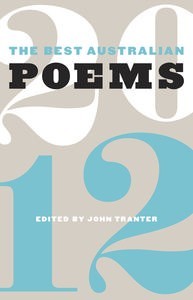
  • One of my poems in ‘The Best Australian Poems 2012’ anthology. Happiness!

    I just received my two copies of The Best Australian Poems 2012 edited by John Tranter.

    I’m honoured to have one of my poems, ‘Sampling Lily’, included.

    You can read more and buy The Best Australian Poems 2012 here.